
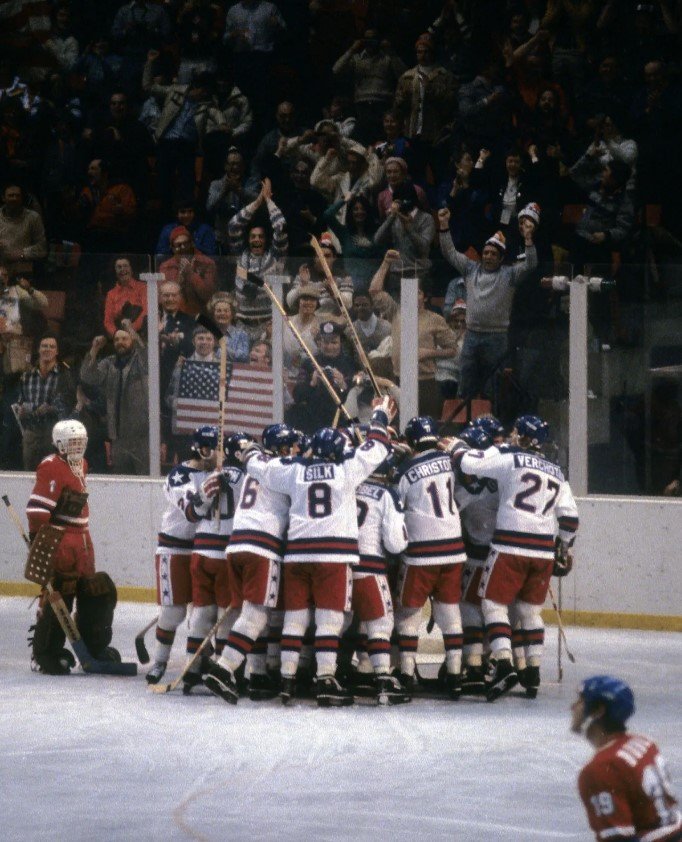
The Miracle on Ice-The wind outside howled through the narrow streets of Lake Placid, New York, as the packed crowd inside the Olympic Center rose to its feet. It was February 22, 1980, and something extraordinary was unfolding.
On the ice stood a group of American kids—college students and amateurs in mismatched gear—facing down the most dominant hockey team in the world: the Soviet Union. For two decades, the Soviets had ruled international hockey with near-total dominance, their red jerseys a symbol of fear and precision. But tonight, under the blinding lights and the weight of the Cold War, everything was different.
Herb Brooks, the fiery and brilliant coach of Team USA, had started building this team months earlier—not from NHL rosters, but from college tryouts. His vision was clear: mold a team that could skate faster, hit harder, and believe deeper than any team before them. Not everyone understood his methods—sometimes abrasive, always demanding—but his players began to understand something more important: belief.
They had already defied expectations by making it into the medal round, but now they faced Goliath.
The Soviets struck first—relentless, mechanical. The Americans answered with raw effort and sheer will. When Mark Johnson slipped the puck past legendary Soviet goalie Vladislav Tretiak just before the first period ended, the impossible began to feel possible.
In the second period, the Soviets took back the lead. The Americans didn’t fold. Goalie Jim Craig, carrying the weight of a nation on his back, turned away shot after shot, his eyes scanning the ice with razor focus.
Then, in the third period, Mike Eruzione—the captain—found the puck on his stick near the slot. Without hesitation, he fired. The puck flew past the Soviet defense and into the net. 4–3. The crowd erupted. It wasn’t just noise—it was hope, pounding against the roof of the rink.
The final minutes stretched for eternity. The Soviets, stunned, scrambled to equalize. They didn’t pull their goalie. They didn’t call a timeout. They weren’t used to losing.
Inside the commentary booth, Al Michaels was gripping his microphone. As the final seconds ticked away, he found the words that would echo through time:
“Do you believe in miracles? YES!”
When the horn sounded, players in red, white, and blue swarmed Craig. Helmets flew, arms raised, tears streamed. The unthinkable had happened. The United States had beaten the Soviet Union in hockey.
But the miracle wasn’t finished yet. Two days later, the Americans would need to defeat Finland to secure gold. They were down 2–1 heading into the third period. Herb Brooks didn’t shout—he just reminded them: “If you lose this game, you’ll take it to your grave.” The team responded with three goals and a 4–2 victory.
Gold was theirs.
Back home, a nation divided by politics, gas lines, and international tension watched in unity as their boys—just boys—stood on the podium. The flag rose. The anthem played. It wasn’t just a hockey win. It was a message to the world that underdogs could rise, that belief could conquer dominance, and that miracles could happen.
In the years that followed, documentaries were made, a Hollywood film told their story, and Jim Craig’s image—draped in a flag, searching the crowd for his father—became part of America’s soul.
But those who were there will tell you: it wasn’t just about a puck or a score.
It was about a moment when America believed again.
-Story series 01 | BiGG Sports News
Follow BiGG Sports News for sports news and live updates
About the Author


1 thought on “🏅 The Miracle on Ice: A Cold War Victory Written on Ice – 1980”